
Where are students living? What the latest HESA data tells us about term-time accommodation

Image courtesy of Unsplash
Key Findings
- The national live-at-home rate has returned to its pre-pandemic level, falling back to 19.4% in 2024/25.
- Live-at-home rates remain highly localised, ranging from 42.2% in Huddersfield to 2.5% in Durham.
- London’s live-at-home rate stood at 21.9% in 2024/25, equivalent to 93,850 full-time students.
- Since 2019/20, Reading’s live-at-home rate has risen by 14.4 percentage points, while Canterbury and Bristol have seen sharp falls.
HESA Term-time Accommodation Data
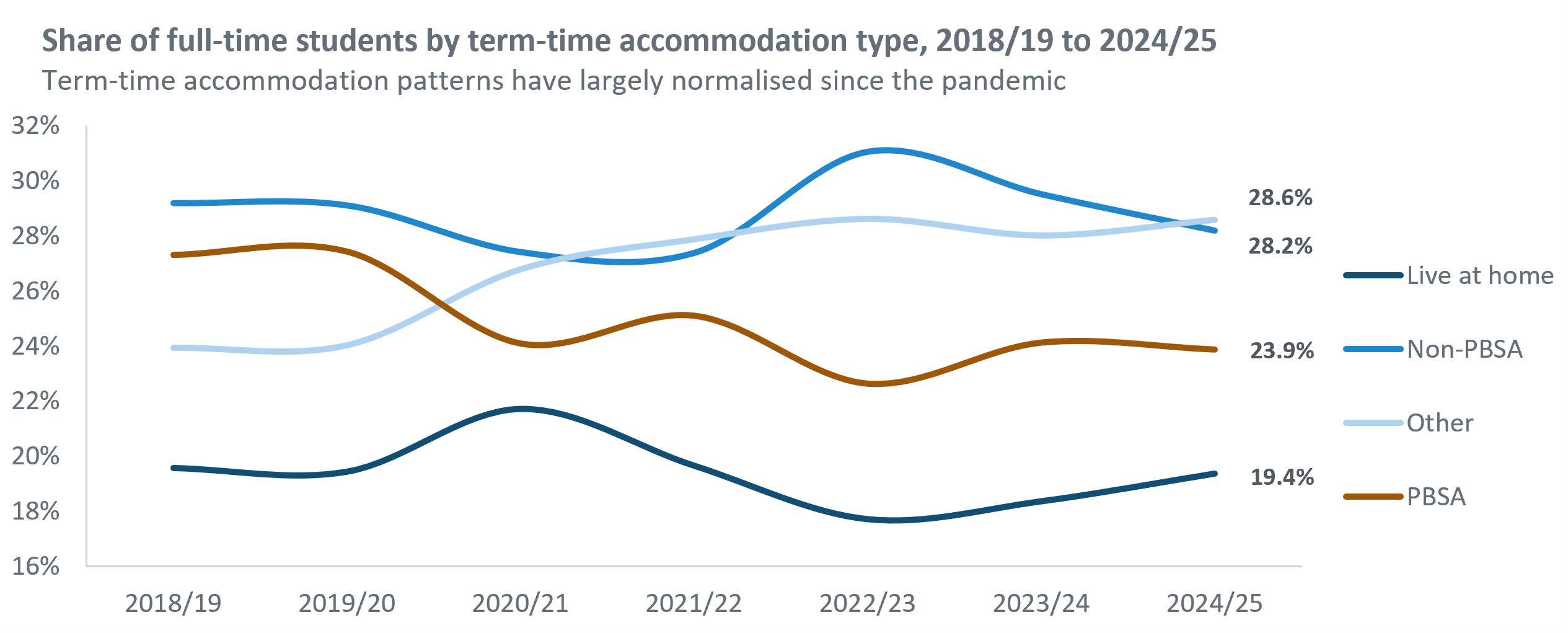
The latest HESA term-time accommodation data shows that the national spike in students living at home has largely reversed to pre-pandemic levels.
In 2019/20, 19.4% of full-time students were recorded as living at their parental or guardian home. This increased to 21.7% in 2020/21, before returning to 19.4% in 2024/25.
At a national level, this suggests that the pandemic did not lead to a permanent change in the proportion of students living at home. However, the city-level picture is more varied.
This analysis focuses on students recorded by HESA as living at their parental or guardian home, with city-level figures based on provider location.
Source: HESA
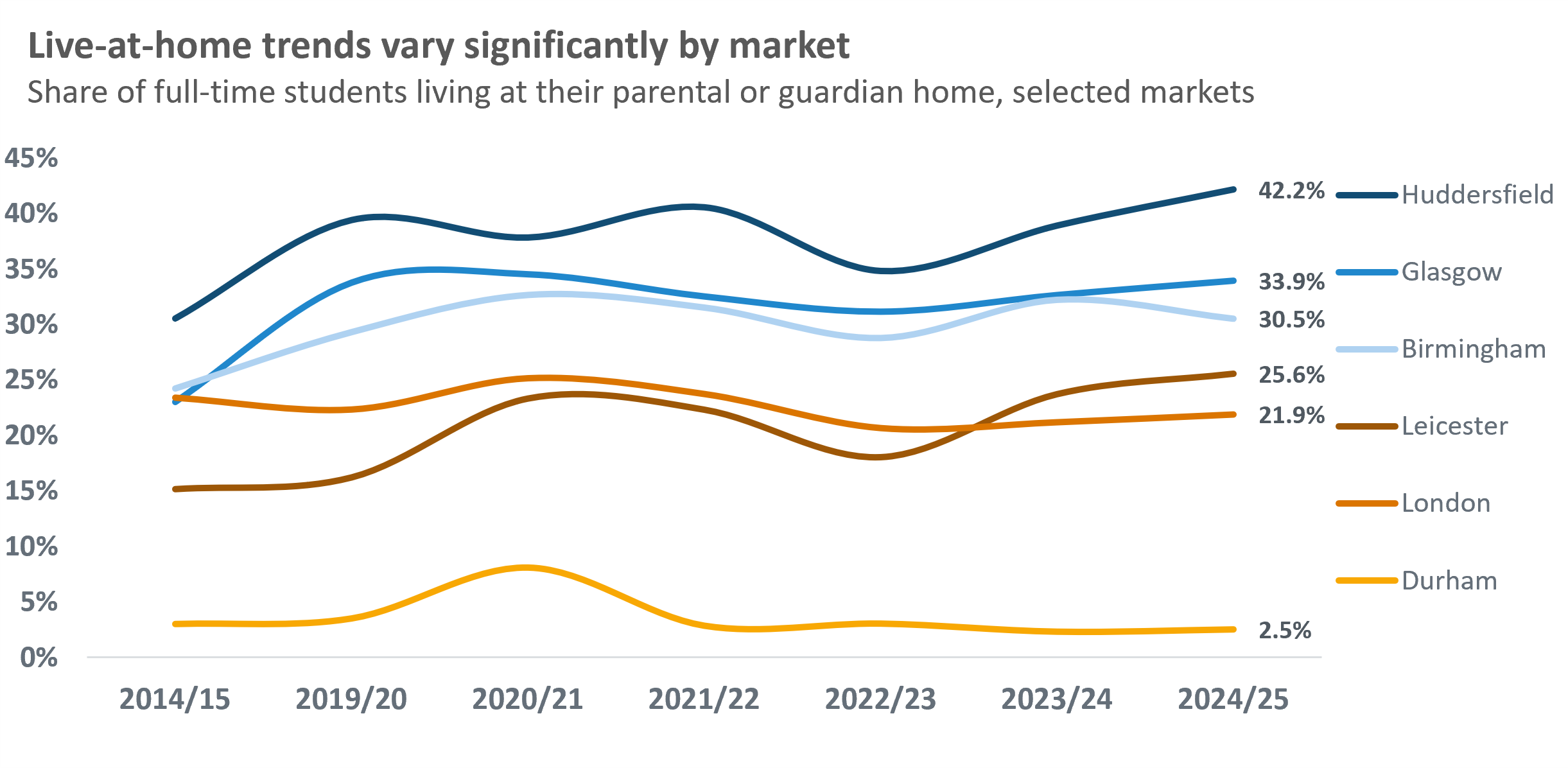
Some localised student markets continue to have a much higher proportion of students living at home.
Huddersfield stands out, with 42.2% of full-time students recorded as living at home in 2024/25. Glasgow and Birmingham also recorded relatively high rates, at 33.9% and 30.5% respectively.
London sits lower as a proportion, at 21.9%, but the size of the market means this still represents a significant number of students. Leicester has also seen a notable increase, rising from 16.2% in 2019/20 to 25.6% in 2024/25.
By contrast, Durham remains a very low live-at-home market. In 2024/25, just 2.5% of full-time students in Durham were recorded as living at their parental or guardian home.
From a market fundamentals perspective, strong student numbers do not necessarily translate into strong accommodation demand, particularly in cities where a large share of students live at home.
Source: HESA
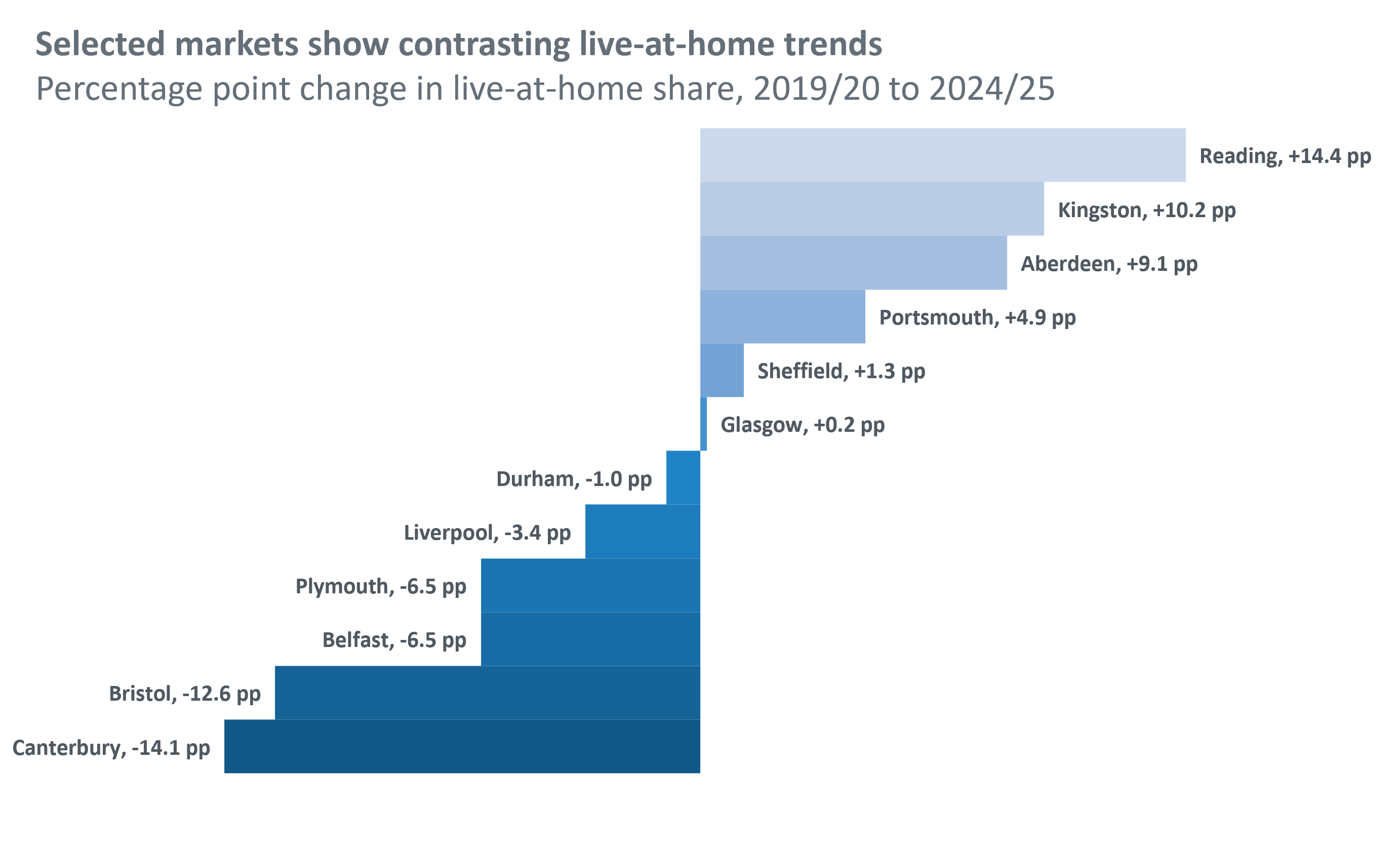
Comparing 2024/25 live-at-home rates with 2019/20 shows how varied these trends can be.
Reading recorded one of the clearest increases among the selected markets, with its live-at-home rate rising by 14.4 percentage points. Kingston also increased by 10.2 percentage points, while Aberdeen rose by 9.1 percentage points.
Other markets moved in the opposite direction. Canterbury’s live-at-home rate fell by 14.1 percentage points, while Bristol fell by 12.6 percentage points. Belfast and Plymouth both recorded declines of 6.5 percentage points.
Not every market has changed significantly. Glasgow remains a high live-at-home market, but its rate was broadly stable between 2019/20 and 2024/25. This distinction is important. Some places have high live-at-home rates as a long-standing feature of the market, while others have seen more noticeable movement since the pre-pandemic period.
Source: HESA
What this means for accommodation demand
The latest HESA data reinforces the need to look beyond headline student numbers.
At a national level, the live-at-home spike seen during the pandemic has largely unwound. However, local trends remain important. Some markets continue to have a high proportion of students living at home, while others have seen meaningful changes since 2019/20.
Share

Article by
Research Analyst at StuRents
Calum Martin is a research analyst in StuRents’ research division, StuRents Intelligence.
