
UCAS June data suggests further undergraduate growth

Image courtesy of Flickr
UCAS has now released its latest applicant data as of the June deadline, painting a broadly positive picture across the board.
The latest deadline accounts for ~90% of anticipated applicants, so it provides an up-to-date view with regard to undergraduate demand. Of course, not all these applicants will convert to acceptances, but it’s still a useful barometer of how demand could evolve for the 2026-27 cycle.
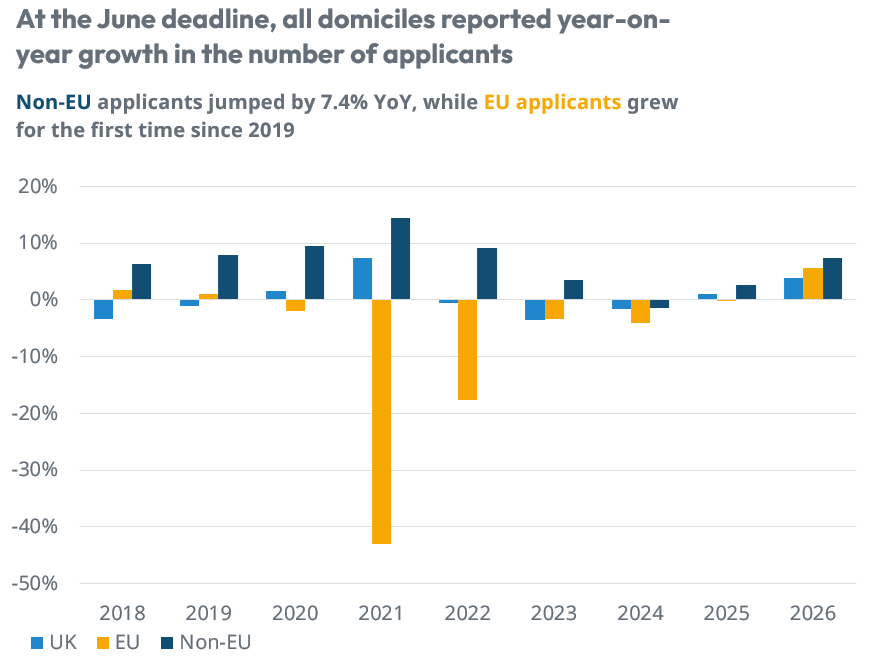
At a headline level, total applicant numbers are up by 4.6% year-on-year, with all domiciles reporting growth. Moreover, the application rate of UK 18-year-olds remained broadly steady at 41.4%, indicating that demand for higher education remains intact.
At a domicile level, the largest increase was attributed to non-EU students, with applicant numbers increasing by 7.4% compared to 2025. Meanwhile, applicants from the UK and EU grew by 3.9% and 5.6%, respectively. This represents the first year-on-year increase in EU numbers since 2019, albeit applicants from the EU still equate to a relatively small proportion of the total (3.3%).
Source: UCAS
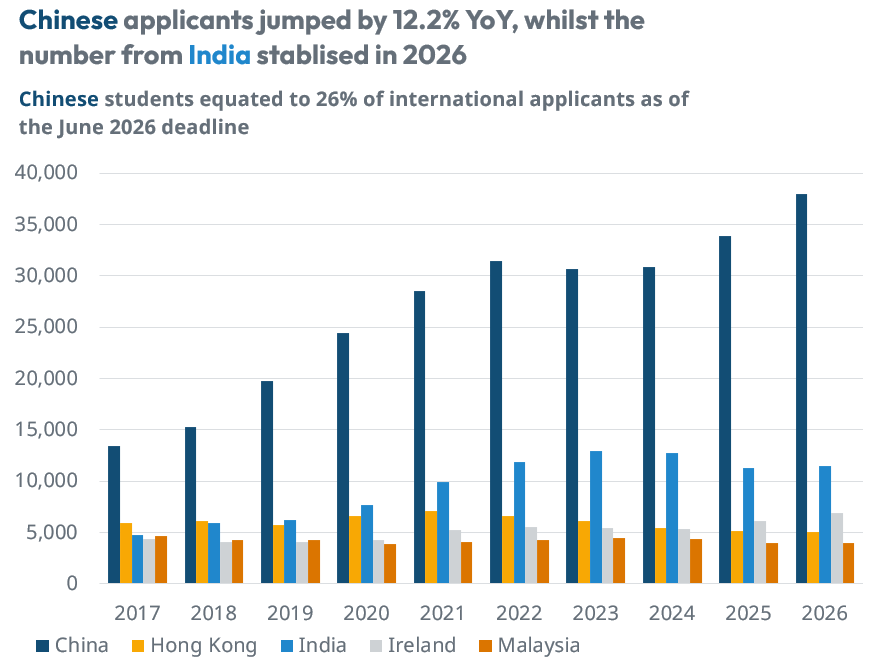
At a country level, a significant proportion of the rise in non-EU applicants can be attributed to continued growth in demand from China, with numbers rising by 12.2%. Isolating non-EU applicants, those from China now equate to 25.6% of the total, up from 15.0% recorded in 2019. Positively, demand from India has now stabilised, with applicant numbers growing by 1.4% year-on-year, following a double-digit decline in 2025.
Source: UCAS
While growth in applicant numbers will be well received by the sector, the apparent rise in the number of students seeking to live at home will somewhat act as a counterbalance.
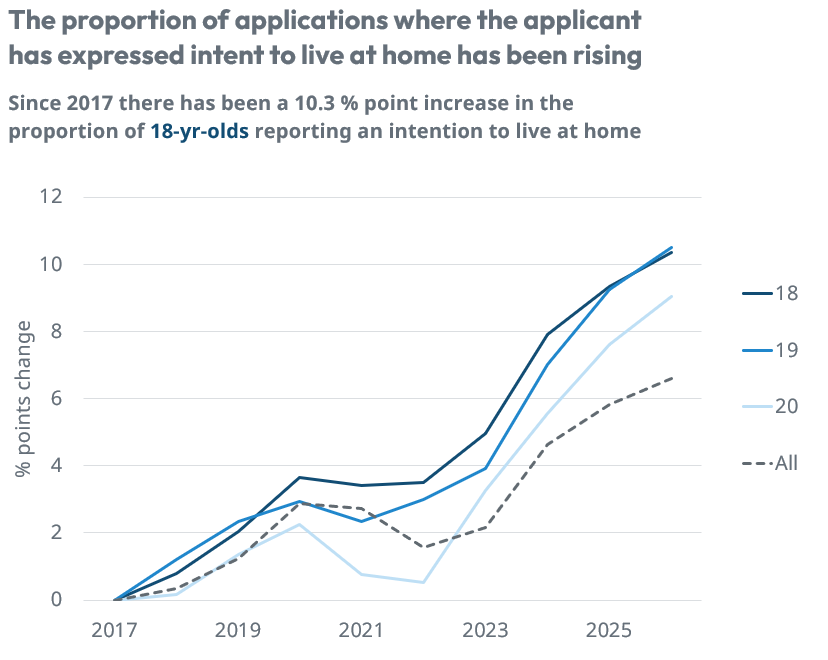
Although the data from UCAS only tracks the intention of students, which could differ from their final decision, the trend remains one in focus given the impact it has on the demand for accommodation.
The data released as part of the June deadline specifically highlights the proportion of applications where the student has expressed an intent to live at home. On an aggregated basis, this increased to 34.8% in 2026, up from 34.1% in the previous year. However, the all-important 18-19 year old categories, which equate to more than 80% of applicants, saw their proportions grow to 28.7% and 33.6% respectively. As a result, both of these age groups have reported more than a 10 percentage point increase compared to 2017, when only 18.4% and 23.1% expressed an intention to live at home.
Source: UCAS
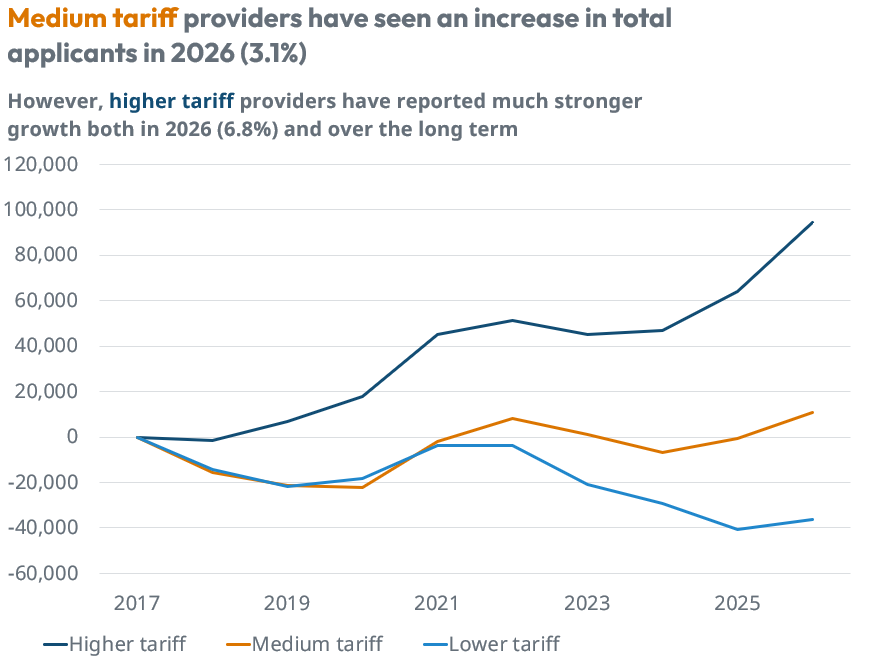
The flight to quality trend has been well reported and the latest data from UCAS shows a continuation in this trend. While all provider groups reported growth, those deemed as higher tariff continued to outperform, with applicant numbers increasing by 6.8%. In comparison, medium and lower tariff providers reported growth of 3.1% and 1.3% respectively. Over the long term, as of the June deadline, there were almost 95k additional applicants at higher tariff providers in 2026 compared to 2017. At the other end of the spectrum, despite the year-on-year increase, lower tariff providers reported 36k fewer applicants this year over the same period.
Source: UCAS
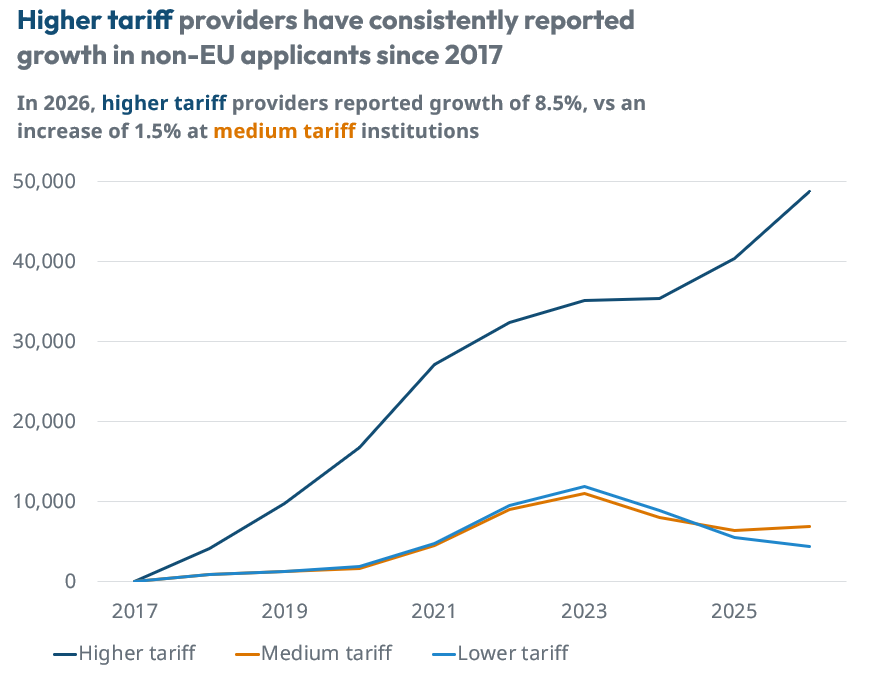
These trends become even more stark when isolating non-EU applicants. As highlighted below, higher tariff providers reported year-on-year growth of 8.5%, taking the total increase in yearly applicants to 49k compared to 2017. While both medium and lower tariff providers have reported growth over the long term, this has been minimal in comparison.
Source: UCAS
The latest data from UCAS broadly points to a continuation of recent trends, albeit important ones for those looking to understand changes in demand for accommodation. Of course, these figures do not include postgraduate demand, which in recent years has been extremely volatile, creating uncertainty and occupancy challenges in certain markets. All eyes will now be on the end-of-cycle data to understand the conversion rates of these applicants.
For up-to-date data to support rent setting, underwriting, and broader industry benchmarking, the StuRents Data Portal provides users with instant access to sector-leading data.
Share

Article by
Head of Research at StuRents
Richard leads the StuRents research team, providing proprietary, platform-driven insights to help stakeholders make better-informed decisions about the market.
