
Chinese Student Recruitment and UK PBSA, Part 1: Why It's Getting More Competitive

This article was written in collaboration with Gabriel Nicklin, Managing Partner of TONG Global. TONG Global is a specialist bicultural China marketing agency, with offices in London and Shanghai, helping luxury, real estate, and consumer brands connect with Chinese consumers worldwide.
For over a decade, Chinese students have been one of the most important international student groups in the UK. Strong historic demand, supported by factors like rising household wealth and prestige in overseas education, has been driving years of sustained growth for both institutions and the purpose-built student accommodation (PBSA) sector. However, a combination of demographic, economic, policy and competitive shifts is reshaping this landscape.
Chinese students and their families are becoming increasingly selective about higher education, expecting a return on investment from international study as cost pressures rise and China’s domestic higher education sector rapidly improves. Simultaneously, macroeconomic pressures, changing policies and demographic trends are influencing student decisions. The result of this is a more competitive landscape for UK PBSA and further financial pressures on institutions.
Importantly, this doesn’t mean that demand from Chinese students is fading, but that the market is becoming more competitive, selective and complex; institutions, operators and investors need to understand how to approach the market now that things are changing. Those who continue to rely on historic patterns may find themselves exposed, and, ultimately, those who succeed will be those who can leverage available data and services to understand demand and macro trends.
The warning signs
Estimates from the Higher Education Statistics Agency (HESA) indicate that Chinese student enrolments in both UK undergraduate and postgraduate programmes peaked around 2022, following more than 5 years of sustained growth. Since then, numbers have been gradually declining, ultimately reflecting the suite of factors affecting Chinese students.
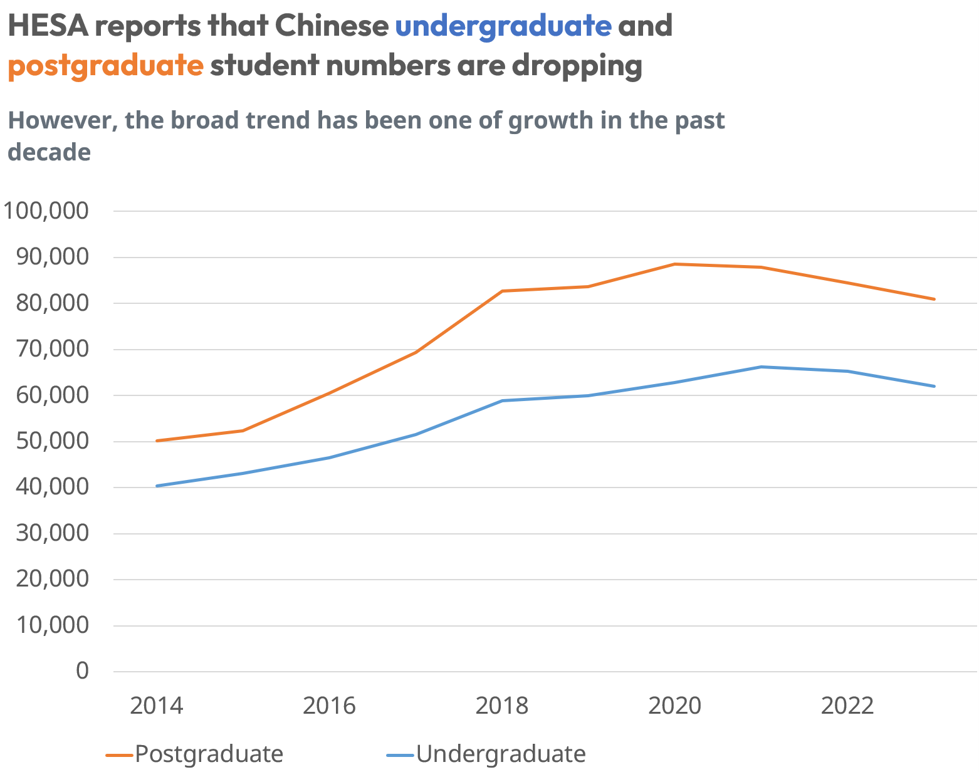
Source: HESA
This, alongside the growth of Chinese universities as part of the global elite, results in a highly competitive market that can no longer rely on the status quo to succeed. While Chinese families and students still highly value the UK as a study destination, their options for both international and domestic study are wider than ever before, putting increased pressure on UK universities and PBSA alike.
Chinese students remain one of the highest-spending international student demographics and often play an important role in supporting occupancy and rental performance, particularly in major university cities. Changes in recruitment patterns can therefore have implications not only for institutions, but also for PBSA operators, investors and developers exposed to international demand.
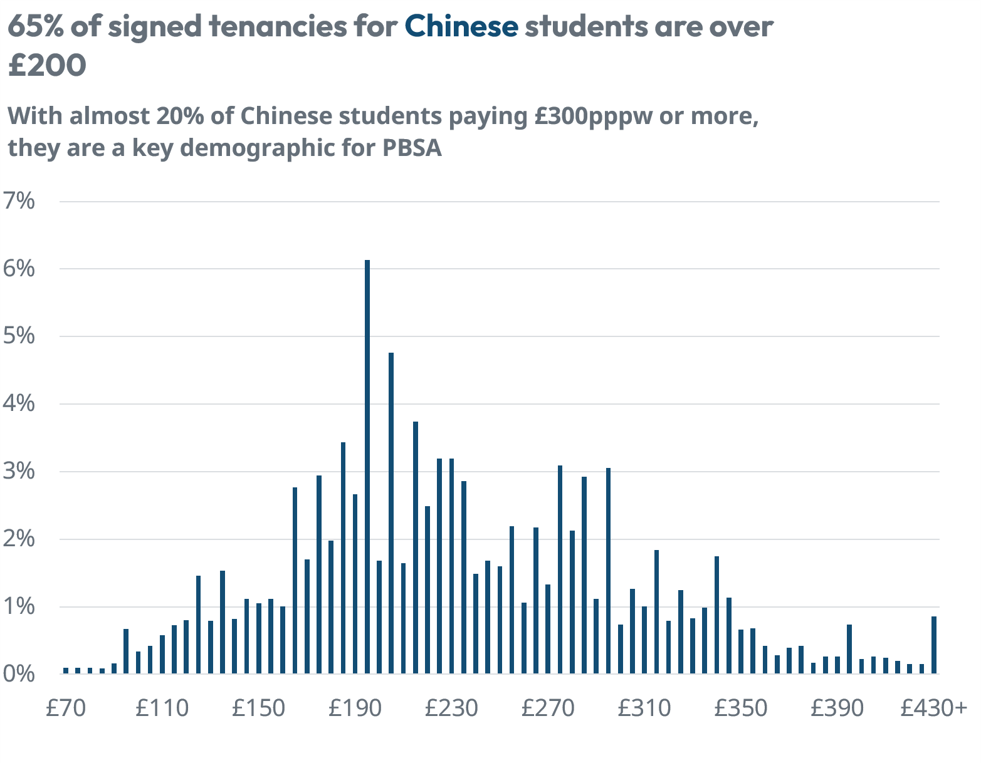
Source: Concurrent
How Chinese families’ decision-making has been evolving
Although total Chinese student numbers across all UK higher education levels fell to roughly 143,200 in 2024/25, down from 149,900 the previous year, UK undergraduate applications from China through UCAS hit a record 33,870 for 2025 entry, up 10% year-on-year, before growing again to around 38,000 for 2026 entry by June - a further 12% growth.
It is worth remembering then, that the total numbers are up by more than 50% in the decade to 2024/25, and enrolment from Chinese students in UK institutions is not far below record levels. While the US hosts more Chinese students each year, the UK consistently ranks as the top choice by reputation for both students and parents - driven by institutional reputation and educational quality, a perception of safety, and a well established international student ecosystem.
What then, are the key factors driving a slight decline in postgraduate study, while keeping undergraduate applications robust? And how are Chinese families making the complex decisions about where to study?
Firstly, cost is a stronger factor in these decisions than ever before. The average Chinese study-abroad budget now sits around 600,000 RMB (c. £65,000), and return on investment has become a central part of the calculation. Currency movement adds a further layer to that calculation, with fluctuations in the GBP/CNY exchange rate impacting on decision-making. A budget of 600,000 RMB was worth £78,000 in 2022 versus £65,000 today - a drop made more acute when factoring in rising fees and living costs over the past few years.
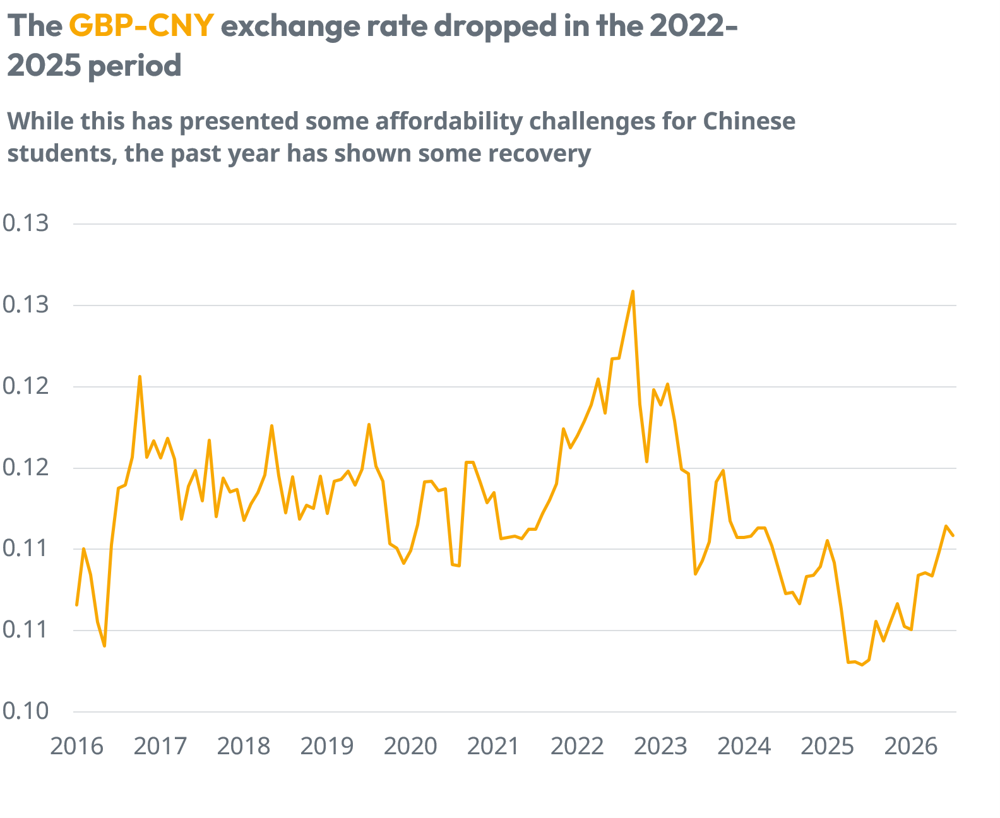
Source: Google Finance
Related to this focus on cost and value for money is the growing scepticism around so-called ‘water degrees’ (shui wenping). This term is used to describe overseas qualifications perceived as low-rigour or purely transactional. A relentless focus on rankings - in particular the QS rankings - reflects this, with the UK’s research-focused Russell Group institutions showing particular popularity with Chinese students.
The race to improve China’s job market and national economic growth has led to changing subject availability at university. Between 2021 and 2025, Chinese universities ended 12,200 undergraduate degree programmes that were deemed oversaturated and obsolete for the future economy (mainly in the arts, humanities, and management). At the same time, 10,200 new programmes were introduced, focussed on subjects such as artificial intelligence and emerging technologies, as the government pushes business to integrate AI into the national economy. UK universities and accommodation providers must adjust their expectations against this changing choice of subject matter for Chinese students.
Secondly, China’s hyper-competitive job market is changing behaviour. It is true that an overseas degree, particularly from a Top-100 institution, still has status in China's among employers, and crucially can unlock hukou migration into major cities. A hukou is a geographic registration system, like the Electoral Register but with much deeper impact, and it restricts where in China you can move to work. Studying abroad in the UK can make it easier for a returning Chinese student to move from, for example, their rural hometown to a national economic powerhouse with greater economic opportunities such as Shanghai or Guangzhou.
That said, a core advantage of studying in China is the access to recruitment networks, and summer internships or placements at major employers. As the graduate job market in China continues to flatline, while the number of roles shrinks due to the impact of AI, having experience is a precious resource to help you stand apart from your peers. This is particularly marked among those pursuing a postgraduate qualification - who are slightly older, and where the pressure to move straight into a job is higher than for those at the beginning of their higher education journey. An undergraduate degree from a UK institution is also seen as a more likely path to longer term employment in the UK - or opening up further study options globally and at elite institutions in Mainland China. Government-backed exchange initiatives like the chunhui programme have now reached 5.63 million students since 2012.
Historically some of these challenges were offset by the prospect of working in the UK post-graduation. However, the same pressures are facing the UK’s graduate employment picture as in China, and proposals to further restrict the post-study work visa have reduced the UK’s advantage. Perhaps fortunately for the UK our primary competitors - the US, Canada, and Australia - have all also been making changes to their systems to the detriment of international student mobility.
Thirdly, the information ecosystem is undergoing another revolution. Social platforms from RedNote (Xiaohongshu), WeChat and Douyin remain crucial as windows into the ecosystem - helping prospective students and residents imagine studying, living, and building a life in new destinations through both branded channels from universities and PBSAs, and real-life posts from their peers in those locations. According to TONG surveys, 93% of Chinese students in the UK used RedNote to research and verify their choice of accommodation.
The coming change in consumer behaviour is driven by the rapid rise of China’s own AI ecosystem. Western LLMs such as Claude or ChatGPT are not easily accessed in China, so domestic players like Doubao (Bytedance), Qwen (Alibaba), and DeepSeek are competing for market share. More than 50% of China’s internet users are now using LLMs - and with the growing integration of AI-powered search within platforms including WeChat and RedNote, ensuring communications are optimised for generative AI outputs is rapidly becoming a key part of digital visibility.
Finally, a growing choice of study destination is compounding all of these considerations.
Regional competition in Asia is widening student choice
Chinese students are also no longer simply making a choice between studying domestically, or in other ‘big four’ locations: UK, US, Canada and Australia. Increasingly, they are being attracted by more local destinations such as Hong Kong and Singapore, which also offer elite institutions that consistently feature in the top 100 universities.
As of the 2027 QS Rankings, Hong Kong features 5 universities within the top 100, with those institutions maintaining or improving their rankings from last year. Singapore has two universities within the top 100, with the National University of Singapore (NUS) sitting just inside the top 10.
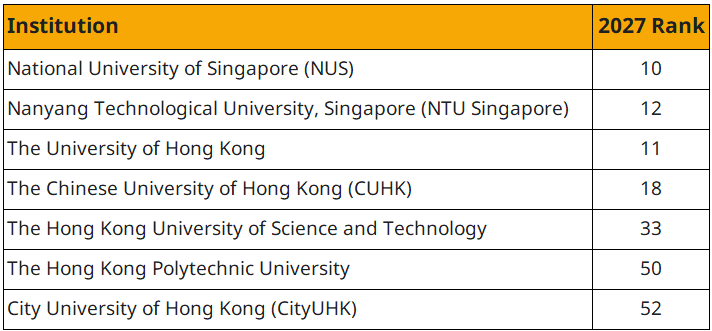
Source: QS World University Rankings
These destinations offer a compelling combination of internationally recognised qualifications, strong employment outcomes, lower costs and proximity to home. For students uncertain about committing to study in Europe, North America, or elsewhere abroad, these options can represent a lower-risk investment while still delivering many of the benefits associated with international education.
As a result, UK universities are increasingly competing not only against each other, but against a rapidly strengthening ecosystem of higher education providers across Asia.
An increasingly competitive higher education system in China
The more significant competition, however, is not regional, but domestic. Outside of changing student expectations, one of the most significant changes is China’s investment in its own higher education sector.
While overseas study remains an attractive option, Chinese universities have become significantly more competitive over the past decade. Government investment programmes such as the Double First Class programme, replacing the earlier Project 985 and Project 211 schemes, seek to improve the overall performance of many Chinese universities and increase their presence among top global institutions. Significant funding has been directed to this with particular emphasis on STEM subjects, advanced technology and innovation, aligning with broader national economic and cultural priorities.
The effects of these programmes are increasingly visible. Chinese universities are steadily improving their representation among various global ranking systems and league tables, with many institutions holding their positions or gaining significantly over the past 5 years. Considering China’s C9 League - an Ivy League or Russell Group equivalent - the majority of these universities appear in the top 100 across multiple university ranking systems. Elite institutions such as Peking University, Tsinghua University and Fudan University now compete directly with leading Western institutions, with all three gaining in the latest QS 2027 rankings.
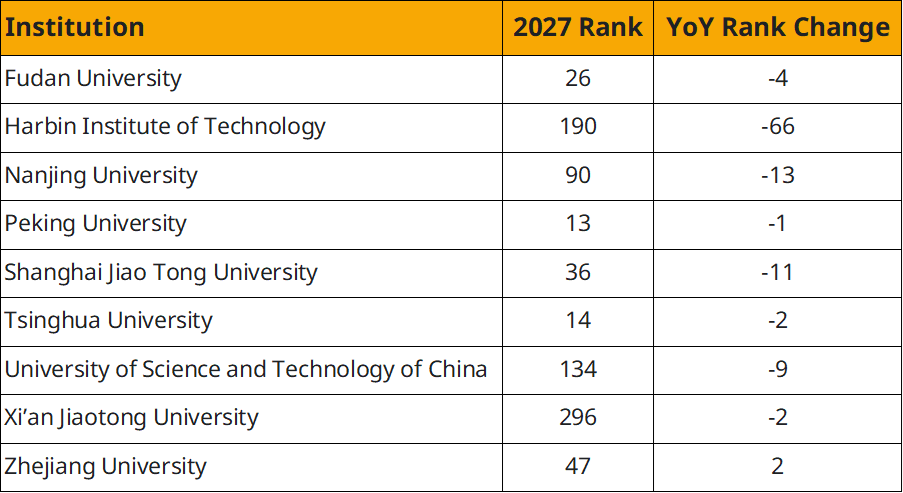
Source: QS World University Rankings
For Chinese students, this provides a genuine alternative to overseas study, particularly given proximity to family, cultural continuity, lower costs, and access to Chinese professional networks. An elite degree from a Chinese university may be viewed more favourably by domestic employers than a qualification from a lower-ranked overseas university, despite the other drawbacks, such as a lack of English-language exposure.
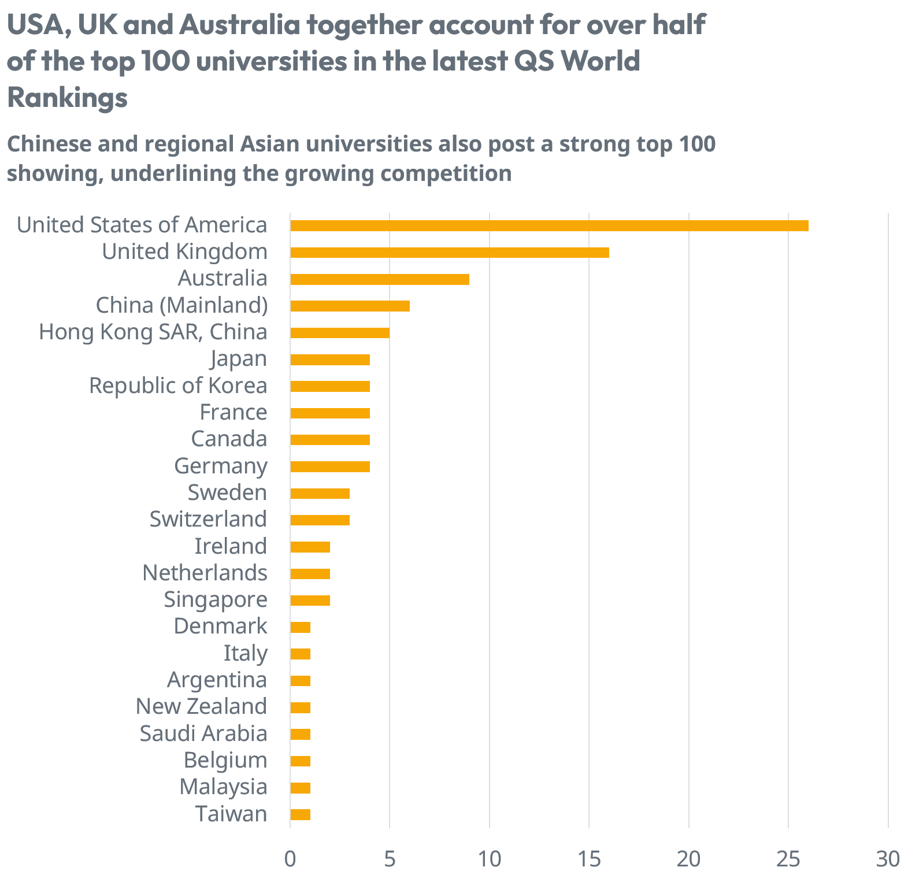
Source: QS World University Rankings
In addition, China has one of the most competitive entrance examinations in the world for higher education. Passing the Gaokao for domestic undergraduate admission is a major achievement, and postgraduate programmes are similarly selective with the Nationwide Master's Program Unified Admissions Examination. Despite the rigorous selection process, data from China’s Ministry of Education indicate significant growth in both undergraduate and postgraduate students at Chinese universities.
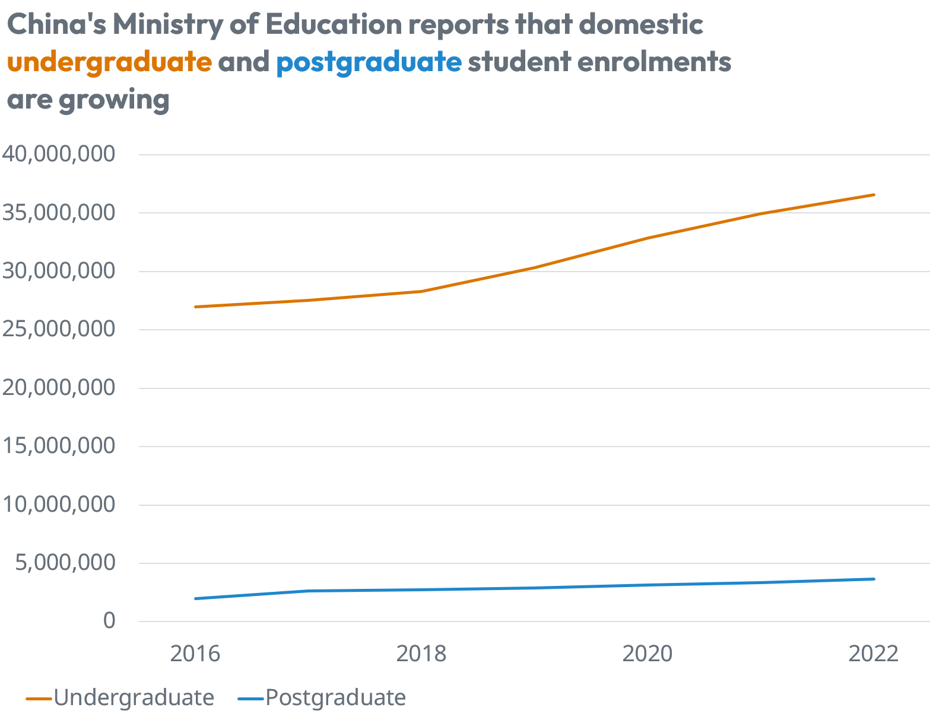
Source: Ministry of Education, People’s Republic of China
Undergraduate in Regular HEIs + Vocational Undergraduate
However, some challenges remain domestically. As in Western nations, graduate employment has become highly competitive, with youth unemployment among 16- 24-year-olds rising in recent years. Students, therefore, need to balance the advantages of domestic education with the potential career opportunities afforded by overseas degrees.
Takeaways
The quality of UK education remains a big draw for young Chinese and their parents - with student numbers still at close to record levels, and a growing trend towards undergraduate degrees. However, a sharper focus on costs and employability, along with growing competition from both China and wider South East Asia, mean that UK HE institutions, student accommodation providers, and the wider industry needs to work harder to justify the investment of living and studying in the UK. Employability is a particularly hot topic.
Additionally, the customer journey continues to evolve and become more complex - as parents and students search out more information than ever before, from a wider array of sources. Providers who can deal with this complexity, and speak to the concerns of needs of their target audiences are well positioned to benefit from the UK’s continuing ability to attract Chinese students to its shores.
Part 2 of this series will look at what this more competitive, more complex market means practically for UK PBSA providers, and what steps to take to achieve success.
Share

Article by
Research Analyst at StuRents
David Reader is a research analyst in StuRents’ research division, StuRents Intelligence.
