
PBSA supply growth remains restricted, but understanding local variations remains key

Image courtesy of Flickr
PBSA deliveries
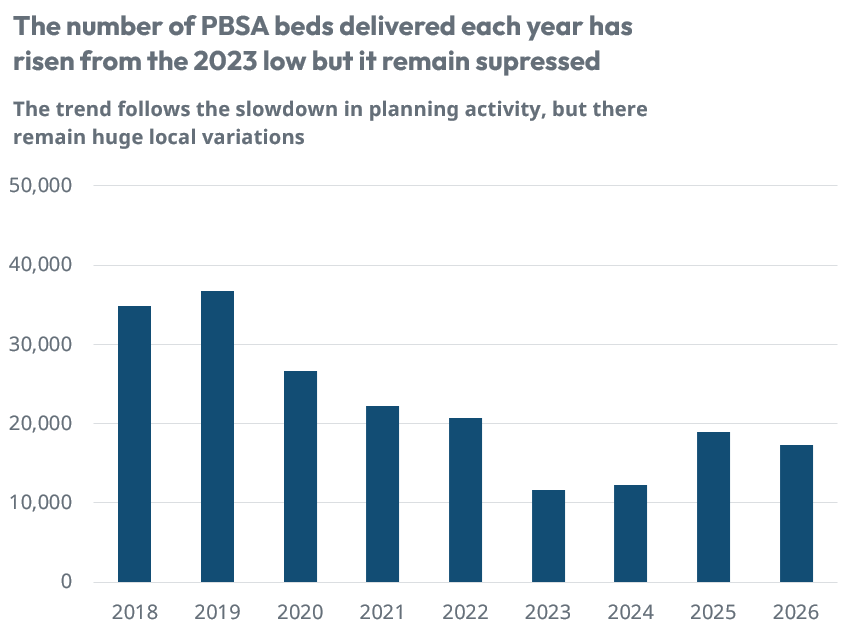
The number of newly delivered PBSA beds is likely to remain well below 18k beds for the 2026-27 cycle, reflecting the broader slowdown in planning activity witnessed in recent years. Since 2019, the number of beds delivered each year has trended downwards, with the five-year average between 2018 and 2022 of 28k beds, much higher than the more recent figure of ~15k recorded since 2023.
Source: StuRents
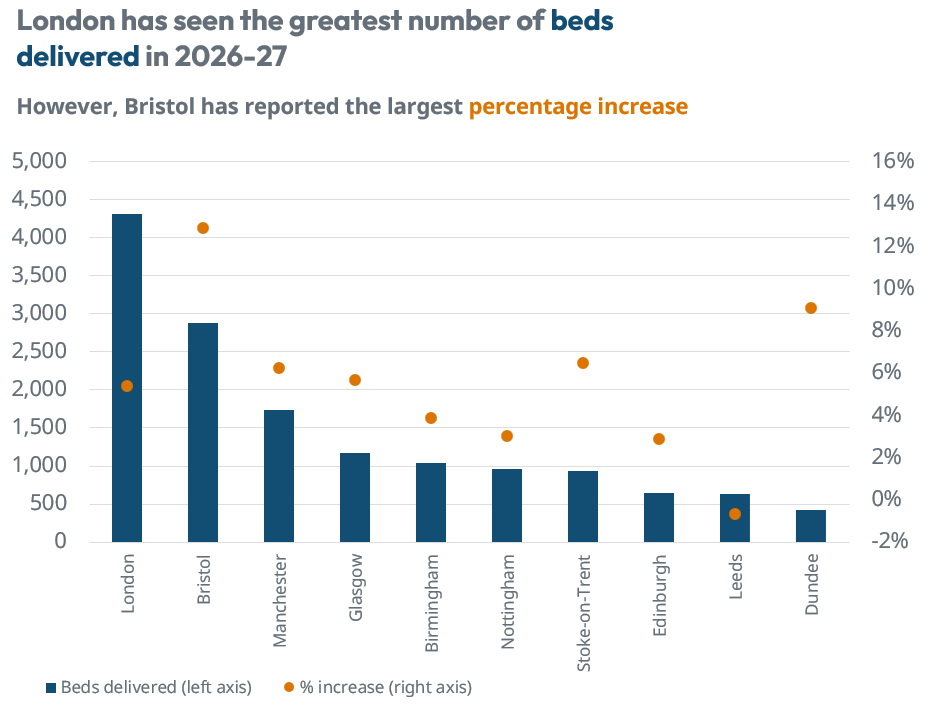
We’ve previously reported on how planning application activity has been skewed to relatively few locations, with development viability too high a hurdle to overcome in many regional cities. As a result, newbuild delivery is also unevenly distributed. In 2026, London will see the greatest number of new beds delivered at more than 4k, although this equates to a percentage increase in PBSA supply of less than 5%. In comparison, Bristol will see ~2.8k beds delivered, resulting in PBSA supply growth of >12% year-on-year.
Meanwhile, other locations such as Leeds could actually report a reduction in supply despite new stock being delivered, due to the withdrawal of some previously operational assets.
Source: StuRents
Planning activity
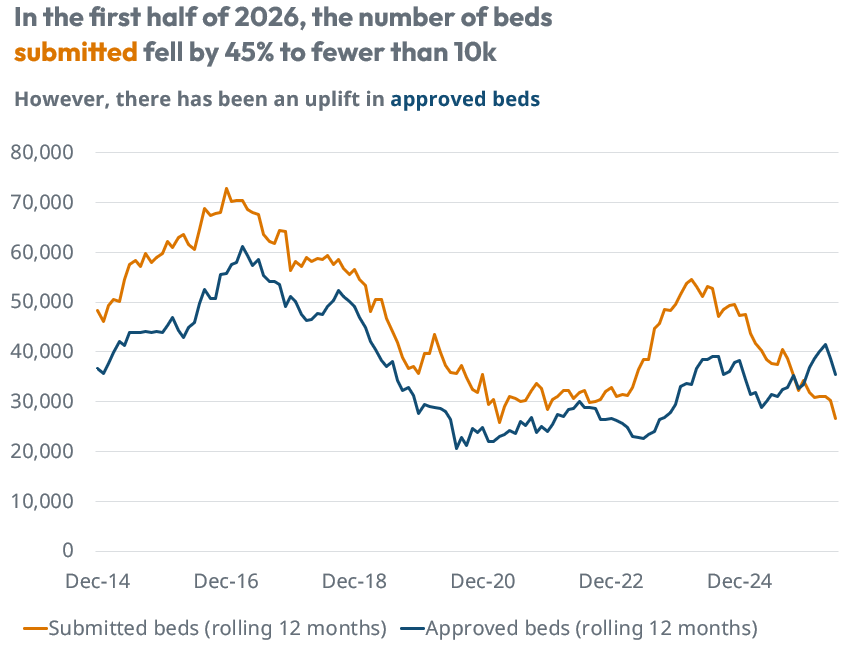
As highlighted, this slowdown in the delivery of beds correlates to a lack of planning activity. Since peaking in 2016, which contributed to the delivery of 39k beds in 2019, the number of units being proposed has been sliding. After a moderate spike in 2023, leading to ~50k beds being submitted, the trend has been clear and consistent, with fewer units being put forward. Although in recent months there has been a decoupling between submissions and approvals, this is expected to be short-lived given the recent fall in new applications.
In the first six months of 2026, fewer than 10k beds were proposed, representing a year-on-year decline of 45%. In contrast, a total of ~15k beds were granted planning permission, a 16% rise compared to the same time last year, but well off the 27k approved in the same period of 2017.
Looking forward, the slowdown in the number of applications being put forward suggests that the delivery of new PBSA will remain suppressed, which will be welcome news to those with operational stock.
Source: StuRents
BTR impact
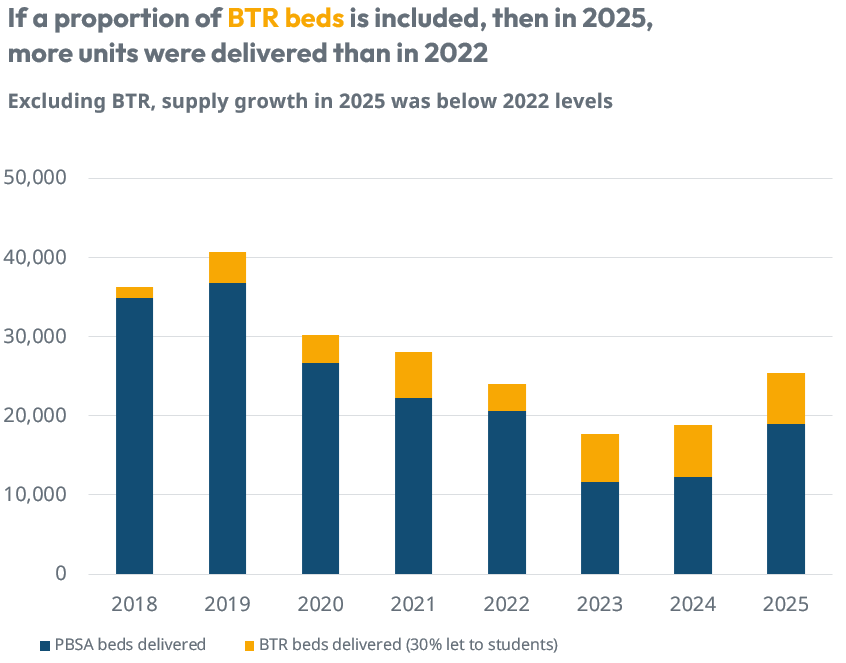
While still relatively nascent in comparison to PBSA, the rise of the build-to-rent market has, in recent years, started to impact certain markets. While the general industry consensus is that ~30% of BTR units are being taken up by students, the figure must be treated with caution, given the lack of visibility and transparent data in the sector. However, even on this basis, growth in supply can materially change once BTR is factored into the analysis.
Take the most recent complete year. During 2025, once 30% of BTR beds are included, supply growth during the 12 months is likely to have outstripped that recorded in 2022. While simplistic, this shows a very different story, as without the inclusion of BTR, growth in 2025 was below 2022 levels. Even though a microcosm of the trend, it shows how the story or outlook can be in complete contradiction depending on whether this asset class is included or not. This illustrates the importance of taking into account multiple asset types for any stakeholder looking for an accurate assessment of market fundamentals.
Source: StuRents
As the sector continues to mature, the availability of data keeps rising. However, this creates both opportunities and risks. For those with access to timely, unbiased information, there is an opportunity to explore trends and understand market fundamentals in a way not previously possible. For those without, decision-making will be based on partial or incomplete information, impacting the likely performance of an investment.
For up-to-date data to support rent setting, underwriting, and broader industry benchmarking, the StuRents Data Portal provides users with instant access to sector-leading data.
Share

Article by
Head of Research at StuRents
Richard leads the StuRents research team, providing proprietary, platform-driven insights to help stakeholders make better-informed decisions about the market.
