
Nottingham: A city of two halves

Image courtesy of Flickr
Nottingham’s student housing market has fundamentally changed over the last few years. After almost a decade of sustained demand growth, total student numbers have been in decline at a time when new purpose-built student accommodation (PBSA) continues to be delivered. While at a city level the challenges are well reported, the two universities are continuing to diverge, impacting both PBSA and houses in multiple occupancy (HMOs).
Changing demand
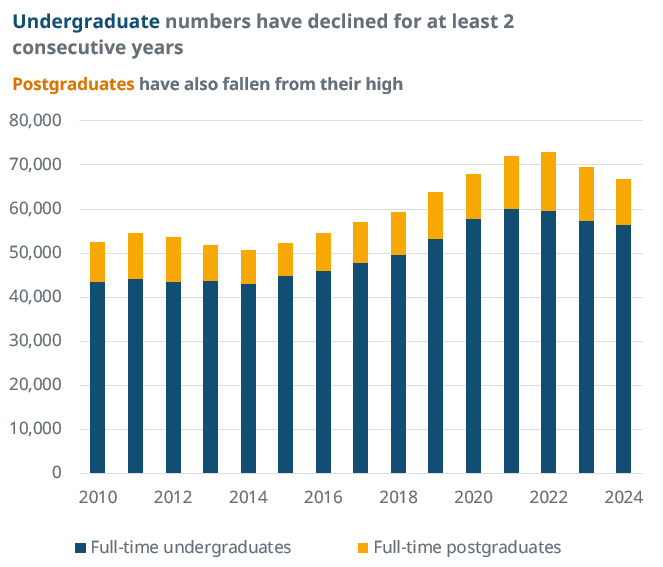
The total number of full-time students in Nottingham has fallen for at least two consecutive years, and while we don’t have figures for 2025 yet, expectations are for a further decline.
In 2024, undergraduate numbers declined by 1.4% year-on-year, while postgraduates fell by 15.4%. For HMO landlords, the continued decline in undergraduate numbers will be of particular concern, given they form the majority of demand for this accommodation type. Compared to the peak recorded in 2021, undergraduate students are now 6.2% lower, representing around 3.7k fewer students.
Source: HESA
However, the headline figures hide some important differences between the city’s two institutions.
A tale of two universities
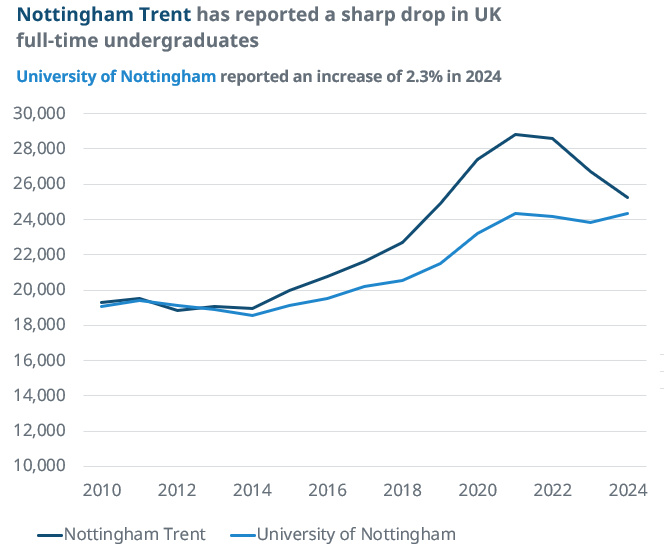
Looking at UK undergraduates in isolation, demand has been diverging. Nottingham Trent University saw numbers fall by 5.4% in 2024, while the University of Nottingham reported an increase of 2.3%. The net impact was a decline of 1.8% across the city, but the variance in demand will have an impact at an intra-city level.
Source: HESA
International students show a similar trend. Nottingham Trent significantly increased its intake in this demographic post-Covid, but has subsequently seen numbers fall by 21.0% in 2024, driven primarily by a decline in demand from India and Nigeria. Conversely, the University of Nottingham has seen its international cohort remain broadly stable.
Drilling into the detail and focusing on Chinese demand highlights some further, important differences. At Nottingham Trent, Chinese student numbers fell by 45% in 2024, albeit from a comparatively low base, but they are now 79% (-630) below their peak in 2018. In contrast, the University of Nottingham grew its Chinese demand by around 16% (455) in 2024. This demand was no doubt buoyed by its inclusion within the QS World University Rankings top 100 and, as a result, the institution has seen Chinese numbers grow by 24% since 2018.
Supply vs. demand
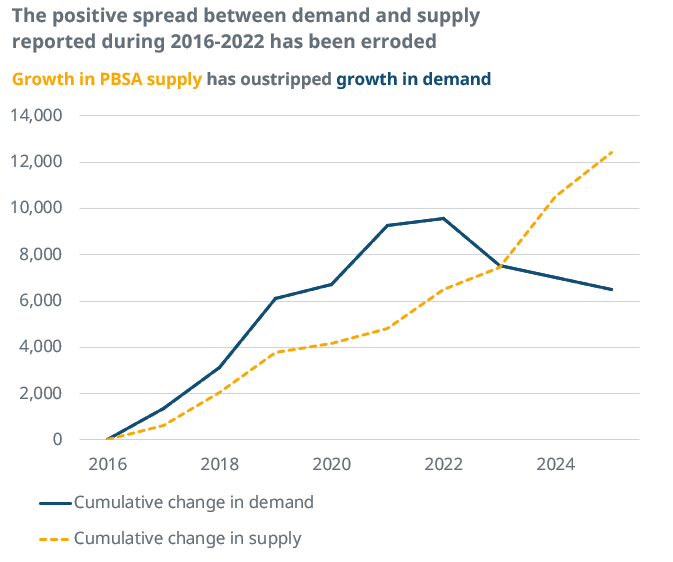
These changes in demand have impacted the supply versus demand fundamentals at a city level. Between 2016 and 2022, cumulative growth in demand outpaced growth in supply, supporting strong leasing velocity and higher rents.
These strong fundamentals helped to elevate the market, which subsequently gained interest from institutional investors. However, not only are we are now seeing a more nuanced picture, the influx of supply has altered the dynamics.
Since 2022, demand has softened, just as new supply has entered the market, resulting in more supply being delivered than new demand. The result of this is more competition from existing providers and lower occupancy. For the 2025-26 cycle, PBSA occupancy as of October stood at just 75%, well below healthy levels.
Source: StuRents
With fundamentals deteriorating, PBSA operators have responded accordingly. Our analysis of executed tenancies across a range of PBSA schemes helps shed light on what levers providers are pulling to help restore occupancy.
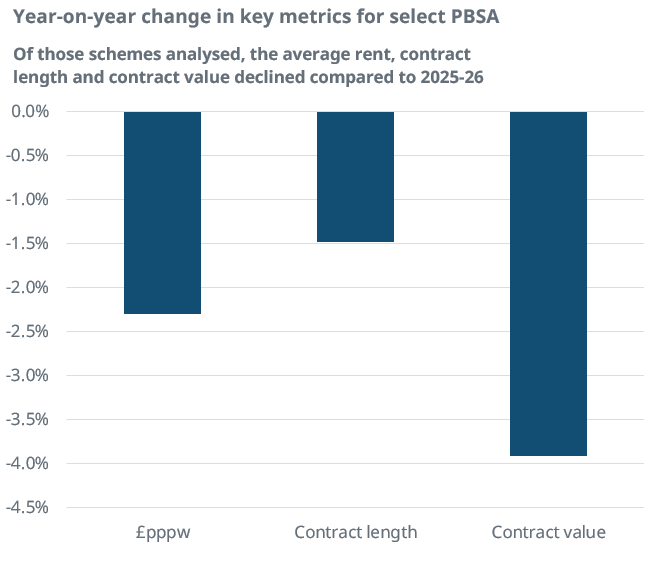
For 2026-27, headline rents across the assessed schemes fell by 2.3% year-on-year, but this isn’t the full picture. The average agreed contract length continued to fall, dropping by a further 1.5% to an average of 46 weeks. Combined, these two factors led to a decline in PBSA contract value of 3.9%, which led to a notable narrowing in the gap between the all-in cost of HMOs vs PBSA.
Source:StuRents
This led to a greater proportion of PBSA being attractive to returning domestic students. Across the schemes analysed, the share of British students within PBSA increased by 4.4 percentage points, equivalent to ~400 students. That’s 400 students that in a previous cycle would have likely entered the HMO market. Of course, the actual figure at a city-level is likely to be much higher, highlighting the importance of understanding secondary impacts and how shifting fundamentals for PBSA can be just as important for HMOs.
Looking ahead
These changing market conditions add up to a significant squeeze on HMOs. The first is a smaller total demand pool, given changes in undergraduate numbers, while the second is indirect but potentially just as significant.
However, the data also highlights that the impact will not be felt evenly across the city. The University of Nottingham has continued to increase its pool of relevant demand, ensuring that those operators aligned more closely with this institution are likely to outperform the city more broadly.
For up-to-date data to support rent setting, underwriting, and broader industry benchmarking, the StuRents Data Portal provides users with instant access to sector-leading data.
Share

Article by
Head of Research at StuRents
Richard leads the StuRents research team, providing proprietary, platform-driven insights to help stakeholders make better-informed decisions about the market.
