
Chinese Student Recruitment and UK PBSA, Part 2: Next Steps to Success

Image courtesy of Flickr
This article was written in collaboration with Gabriel Nicklin, Managing Partner of TONG Global. TONG Global is a specialist bicultural China marketing agency, with offices in London and Shanghai, helping luxury, real estate, and consumer brands connect with Chinese consumers worldwide.
In Part 1 of this series, we looked at the key drivers for the changing picture of Chinese student mobility to the UK - including the shifting sands of undergraduate and postgraduate demand, competition from new markets, pressures on students and parents, and the changing decision journey.
In Part 2, we’ll explore in more depth what this means for student accommodation providers and think about how they can compete in this evolving environment.
Rapid digital transformation and the Chinese student journey
There has never been more information available about accommodation choices for prospective Chinese residents. Booking agents create listings on their own channels and their salespeople create content on social media about specific properties. More operators than ever are active on Chinese platforms and offer detailed information about their offer through their social media, websites, and WeChat Mini Programs. In addition, Chinese social media is full of user generated content both praising and lamenting experiences at specific sites. Add to that mix changing user behaviour driven by AI adoption, and it can be a real challenge for operators to stay in control of the conversation.
So let’s imagine a customer journey for a prospective resident. They’ve received an offer from their university of choice - for example say Leeds - and are now starting to research where to live. If they have a personal connection who is familiar with the city, then this is likely their first port of call. If not, they head to RedNote and Douyin to search for student accommodation in Leeds. They are presented with an array of content from users: current residents, influencers, agent salespeople, and brands. They likely use RedNote’s native AI tool to create a summarised shortlist based on what others on the platform are saying.
From there, they research their shortlist. Checking official accounts on RedNote and WeChat (if present), speaking to agents, and watching some of the UGC or influencer content they spotted earlier. They might make an enquiry directly with the operator - about distance from campus, laundry facilities, safety protocols at the property. They speak to other future Leeds students whom they have met online to compare notes.
At that point, they involve their parents - who may or may not have been doing their own independent research. The parents check socials, but also the Baidu search engine and the brand’s official website if it is available in Chinese. Cost is probably a factor for them, but safety is the bigger concern. They also use AI - an LLM like Baidu’s ErnieBot, Deepseek, or Bytedance’s Doubao - to ask more detailed questions.
At this point, they are ready to make an enquiry and book. Some will go to agents, some prefer to book directly with the operator. At this juncture, having Chinese language customer support is vital, and it should be available on platforms used by your customers, at the times when they need it.
There are plenty of barriers in that customer journey. China’s atomised digital ecosystem - where platforms do everything they can to prevent traffic from leaving the platform - makes for complex navigation for global providers. Users however are used to a certain amount of platform hopping, researching across several platforms before using another entirely to book.
How PBSAs can compete
The digital ecosystem described above is the primary route for reaching this target audience. Crucial for PBSA providers is understanding how to prioritise, and what type of content works on each platform.
RedNote is the natural promotion platform for providers - content is discoverable, and the core target audience is both already spending time there and uses it as their primary search engine. A combination of first-person content from current residents and influencers carries enormous weight - delivering social proof, and seeming more credible than sales-focused owned content. A single authentic video from a current resident showing their room, their commute, and their friendship group, can outperform a professionally produced campaign. Branded official accounts then come in to verify and deliver more in depth information, such as area guides, room guides, and more.
WeChat meanwhile provides an opportunity for a rich ecosystem of information. Permanent, evergreen content such as FAQs, booking guides, and more can live on the menu infrastructure of an Official Account, and regular longer form content can showcase granular details about sites, rooms, and communities. It can also be linked to sales and customer service digital infrastructure - such as CRM systems for customer service, and WeChat Mini Programs for enquiry and booking functionality. Removing barriers in the customer journey - for example the recent integration of Concurrent with VivaCity Mini Programs - can give providers an edge in a market with multiple ways to book.
For AI search, optimising for in-app performance on socials is the first step. Securing credible reviews on China’s broader internet ecosystem will ensure visibility on some of the standalone models such as Deepseek, important for parents in particular.
Why China is so important for PBSAs
Chinese students are a disproportionately important international cohort for the accommodation sector. StuRents data shows Chinese students paid an average of £224 per week for accommodation in the 2024/25 cycle, 42% more than the £158 average paid by British students. Preferences diverge just as sharply: British returning students overwhelmingly favour HMOs over PBSA, while Chinese students show the opposite pattern, strongly preferring the security, convenience and "plug and play" nature of purpose-built accommodation.
In an industry where roughly £300pppw is often the rent level needed to make a development viable, the combination of higher willingness to pay and a structural preference for PBSA over shared housing makes Chinese demand a disproportionately important driver of scheme performance, especially in cities already carrying oversupply risk. At the same time, sector-wide PBSA occupancy fell to around 85.4% in the 2025/26 cycle, down 5.4 percentage points year-on-year, with softer postgraduate demand a key contributor. This means that providers exposed to Chinese postgraduate-heavy schemes need a plan, and providers who can capture more of the resurgent undergraduate pipeline have a real opportunity in front of them.
Demographic and economic trends present both risks and opportunities
Looking at demographic and economic trends in China more broadly, the picture is more nuanced than many assume at first glance.
China’s overall population is expected to decline over the long term, creating potential headwinds for demand in higher education. However, there is some nuance in the data by age that presents a different story: while the number of 18-24-year-olds has declined over the past decade, current projections suggest we’re now entering a period of growth, potentially maintaining or supporting future student demand.
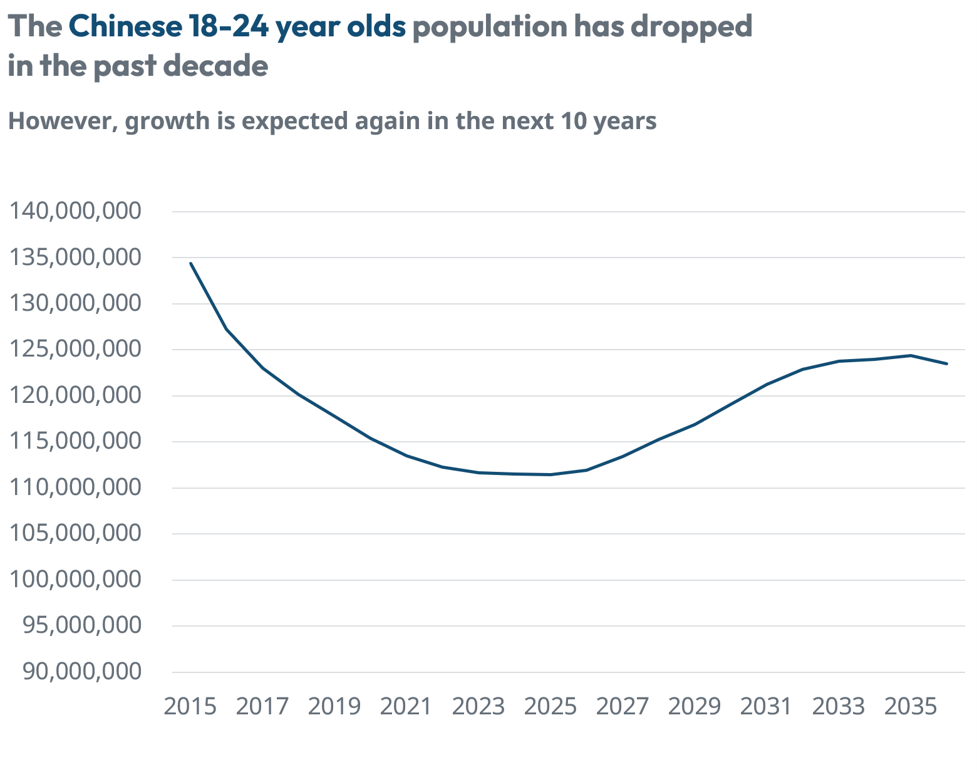
Source: United Nations
At the same time, China’s economy has been growing significantly. Rising GDP and broader indicators of household wealth - such as increased spending on consumer goods - are suggesting that the number of Chinese families with the financial means for overseas higher education may be growing.
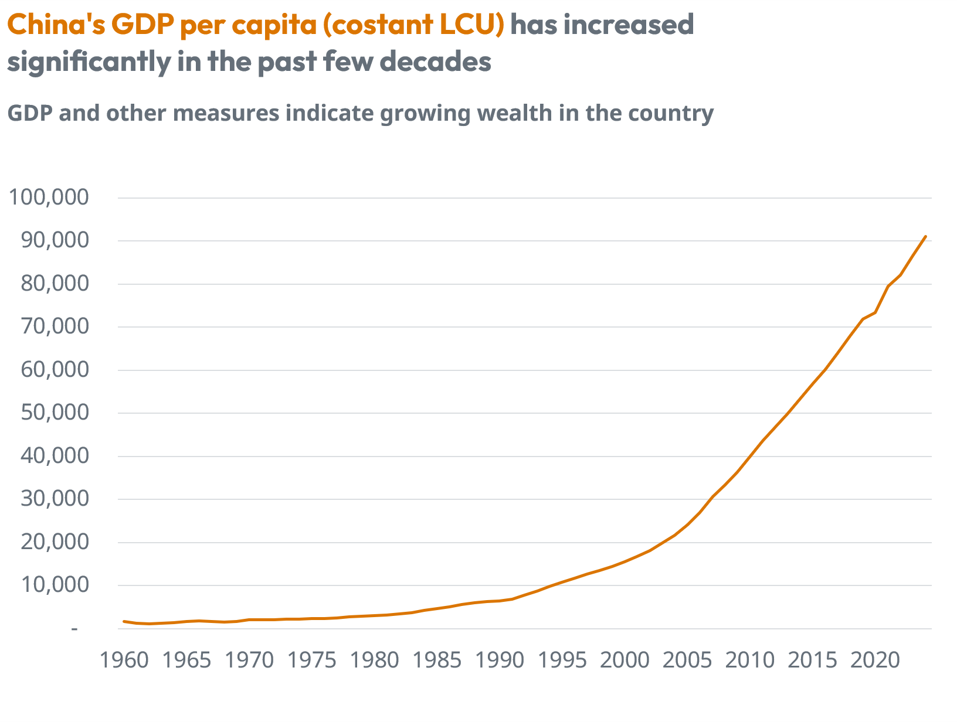
Source: World Bank
This creates an important distinction. While demographic challenges exist over the long term, there are still reasons to be optimistic about future student demand. The addressable market for higher education remains substantial, and the challenge for UK institutions and the student accommodation sector is therefore not necessarily a shrinking market, but a market in which students have more choices than ever before.
For providers evaluating whether to scale back their exposure to China or hold their position, this distinction is important to consider. Since the underlying demand potential isn't disappearing, the more defensible move is to keep investing in Chinese-facing relationships, marketing and pipeline, while also adapting how and where that investment is targeted, rather than retreating on the assumption that the market itself is shrinking.
The need for a tailored strategy
Given how differently distinct Chinese target customer profiles (undergraduate, postgraduate, parents) behave both to each other and to the rest of the target student demographic, a single, generic approach to the Chinese market is unlikely to work. Recruitment, pricing and communication all need to be built around which segment a scheme is actually trying to reach.
Undergraduate-focussed schemes, particularly those near institutions seeing strong UCAS growth from China, should be leaning into the growing demand, while postgraduate-heavy schemes need to diversify their pipeline, adjust letting-cycle assumptions, and plan for lower and later-committing postgraduate volumes rather than hoping the pre-2024 growth pattern returns.
This also means defining who the "Chinese student" persona actually is. An 18-year-old undergraduate applying a year in advance with parents closely involved in the decision has very different needs, budget expectations, and channels of influence than a taught master's student booking accommodation on a much shorter, more price-sensitive timeline. Messaging, pricing structure, and even lease-length flexibility should reflect that.
Building holistic approaches and partnering with universities
One of the strongest opportunities in the sector is also one of the most under-used: accommodation providers and universities need to work far more closely together to sell the UK study experience as a single, coherent, stable proposition, as opposed to two separate transactions that happen to occur around the same time. Convenience and ease are crucial to successful conversion.
In particular, the growing conversation around wellbeing and mental health can be addressed by such partnerships. Community programmes that give Chinese students a support network from day one, from helping with the cultural adjustment, building friendships across nationalities, and giving parents visible reassurance that their child won't be isolated, have proved to counter safety and belonging concerns. Where providers already run this kind of programme, it deserves to be a much more prominent part of the recruitment story.
Implications for UK recruitment and PBSA
The Chinese market remains one of the largest opportunities available to UK higher education and PBSA. However, the conditions that supported rapid growth during the previous decade are changing.
The UK’s reputation, language advantages, educational quality and established international student ecosystem remain key strengths. At the same time, China’s university-age population may stabilise or grow in the short term, while rising household wealth continues to support demand for both domestic and international higher education.
However, decision-making has become significantly more complex. Students now face a wider range of credible options than at any point in recent memory, including increasingly competitive Chinese universities, rapidly improving institutions in Hong Kong and Singapore, and traditional overseas destinations such as the UK, US, Canada and Australia.
Visa policy adjustments across major study destinations, including the UK, have also introduced additional uncertainty for international students. Changes in requirements, dependent policies, work rights during study and post-graduation employment opportunities all influence destination attractiveness. Broader economic and recent geopolitical factors continue to add further complexity.
This does not mean Chinese demand is disappearing. Rather, international study is no longer automatically perceived as the superior option by default. For many students, the decision is now whether the additional cost and complexity of studying abroad is justified against increasingly strong domestic and regional alternatives.
For UK institutions and PBSA providers, the implication is clear. Recruitment strategies, pricing decisions, development plans and investment assumptions all need to reflect a more volatile and segmented demand landscape. Exposure to Chinese is no longer the stable foundation it once was when forecasting occupancy and revenues.
In practice, that means treating not just Chinese students as a different market, but undergraduate and postgraduate demand as different segments as well, while building university partnerships, and understanding how Chinese families and students actually research, evaluate and make choices - success is not just driven by institutional reputation or historical demand patterns anymore, but by the ability for organisations to engage students and families through the platforms, channels and decision journeys they actually use.
For institutions, operators and investors, access to timely, granular market intelligence is also a critical competitive advantage. Organisations that can track demand shifts early, understand pricing and occupancy, and respond to changing student preferences will be best positioned to navigate an increasingly complex recruitment landscape.
For more information about our proprietary, highly granular data covering UK student accommodation, contact the StuRents Research team today. Book a demo of our Data Portal to find out how you can have up-to-the-minute university housing insights at your fingertips, or get in touch with us about our Occupancy Survey.
Share

Article by
Research Analyst at StuRents
David Reader is a research analyst in StuRents’ research division, StuRents Intelligence.
